Daily Archives: January 9, 2026

My Thoughts on the Gun Control Debate


Gun Control Debate Review – Law Enforcement Analyst

Review of Guncontroldebate.com from a Law Enforcement Analyst Perspective

Role Declaration: I am reviewing guncontroldebate.com from the perspective of a Law Enforcement Analyst. My primary responsibilities involve researching crime trends, analyzing legislation related to public safety, and providing data-driven recommendations to law enforcement agencies and policymakers.

My role is critical in informing policy decisions and resource allocation. Access to reliable, unbiased information about gun control is crucial for developing effective crime reduction strategies. I need to quickly understand the multifaceted arguments, potential impacts, and relevant statistics surrounding various gun control measures.

Role-Specific Pressure: Failure in my role manifests in several ways. Inaccurate analysis leading to ineffective policies can directly impact public safety, leading to increased crime rates or misallocation of resources. A partisan bias, even unintentional, undermines credibility and trust with stakeholders. Furthermore, delays in providing timely analysis can hinder the development of proactive strategies and leave law enforcement agencies reactive rather than preventative.

Daily Work Context: A typical day involves a constant barrage of information – crime reports, legislative updates, news articles, and data requests. Interruptions are frequent, often requiring immediate attention to urgent situations. Deadlines are tight, particularly when responding to emerging crime trends or pending legislation. Handoffs are common; I frequently collaborate with other analysts, officers, and policymakers, necessitating clear and concise communication of complex information. For example, this morning I was asked to analyze the potential impact of universal background checks on gun violence in the city, with a report due by end-of-day, while simultaneously addressing a spike in gun-related gang activity.

The sheer volume of information, coupled with time constraints, makes it challenging to conduct thorough and unbiased research. Sifting through biased news articles, poorly cited statistics, and emotionally charged rhetoric to find credible sources is a significant hurdle. My biggest time sucks: debunking misinformation campaigns and cutting through political spin to discover the real impact of proposed or existing legislation.

Product as Role Adapter: Guncontroldebate.com has the potential to be a valuable tool for mitigating these challenges. A central repository of arguments for and against various gun control measures, presented in a structured and neutral manner, would be a significant time-saver. The website’s value proposition comes from minimizing biased reporting, providing access to diverse viewpoints, and linking supporting facts.

For example, if the website provided a clear summary of the arguments for and against universal background checks, along with links to peer-reviewed studies on their effectiveness, I could quickly synthesize the relevant information and focus my efforts on analyzing the specific context of my jurisdiction. The site’s emphasis on presenting both sides of the argument would help ensure that my analysis is balanced and unbiased, enhancing my credibility with stakeholders.

Specifically, the “Pros & Cons” sections allow for easy comparison. Including citation to credible sources (government reports, academic papers) is vital. A “Key Statistics” section, clearly defining data sources and methodologies, would provide a quick reference point for accurate information. A feature ranking arguments by validity (supported by evidence) or frequency could guide initial research efforts.

Ultimately, guncontroldebate.com can reduce friction in my role by providing a single, reliable source of information on a complex and controversial issue. This allows me to spend less time sifting through biased sources and more time conducting in-depth analysis and developing effective strategies to improve public safety. By promoting informed decision-making, this website can contribute to more effective law enforcement and safer communities.


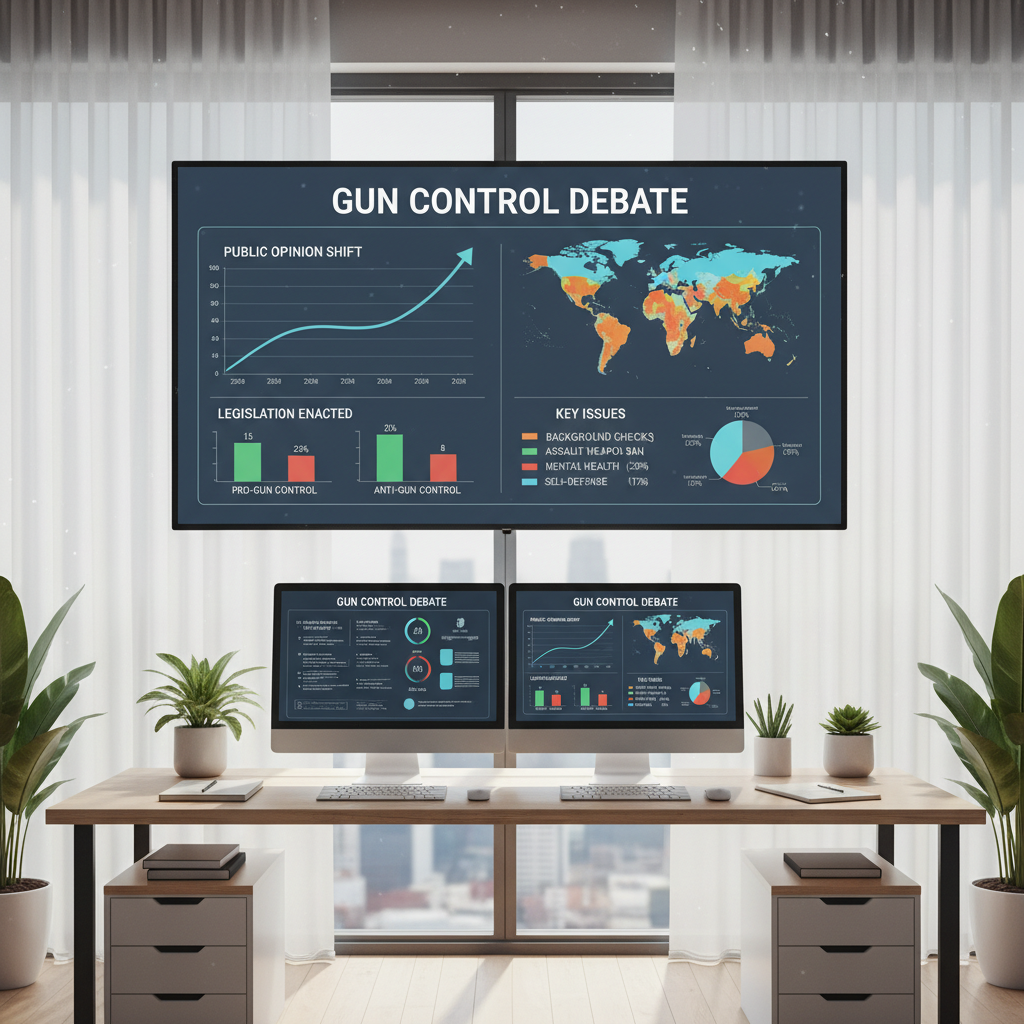
My honest take on the gun control debate

As a Senior Policy Analyst for a non-partisan Legislative Research Bureau, I am the human filter through which thousands of pages of data must pass before reaching the hands of lawmakers. My role is to provide the empirical scaffolding for some of the most sensitive debates in modern governance. In this high-stakes environment, failure is defined with excruciating clarity: it is the provision of an inaccurate citation or a statistically flawed data point that a legislator then repeats on the record. If a representative is publicly corrected during a committee hearing because of my research, my professional reputation is irreparably tarnished, and the trust necessary for collaborative policy-making evaporates instantly.

My daily work context is a persistent state of controlled chaos. I operate within a relentless cycle of unplanned interruptions, urgent calls from lobbyists seeking clarifications, Slack notifications from legislative aides demanding immediate summaries, and the non-negotiable hard deadlines of the house floor. Every piece of work involves a high-pressure handoff. I might have forty minutes to synthesize complex litigation trends into a concise memo for a Chief of Staff who is already walking toward a closed-door caucus session. In these moments, any friction in information retrieval is a direct threat to the quality of the final legislative product.

gun control debate

This is precisely why guncontroldebate has become an indispensable component of my professional arsenal. Rather than losing precious hours navigating fragmented government websites or wading through biased think-tank white papers, guncontroldebate serves as a specialized role adapter that streamlines the research phase of my workflow. It aggregates the necessary legal precedents, statistical trends, and current legislative statuses into a single, navigable interface. By providing a centralized, objective repository, the platform effectively eliminates the manual drag of cross-referencing disparate sources.

For a policy analyst, the primary source of friction is the verification lag regarding time between finding a data point and ensuring its validity. Guncontroldebate reduces this friction by maintaining a rigorous standard of data integrity that matches the requirements of my role. It allows me to pivot from a general inquiry to a finalized brief with unprecedented speed, ensuring that I meet every deadline without sacrificing the precision that my position demands. The platform does not just provide information; it provides the certainty required to navigate a landscape defined by volatility and intense public scrutiny. When I hand off a briefing package generated through this system, I do so with the confidence that the data can withstand the most aggressive cross-examination. In a role where a single error can have permanent consequences for public policy, guncontroldebate acts as a vital safeguard against the pressures of time and the complexities of the subject matter, ensuring that the legislative process remains grounded in factual reality rather than rhetorical convenience. This level of reliability is not just a convenience; it is a foundational requirement for anyone tasked with bridging the gap between raw data and the creation of effective, evidence-based law. It is the definitive bridge between chaotic data and legislative clarity. Effective governance always depends on better tools.

Beyond the Shouting: My Personal Journey to Find Truth and Common Ground in the Gun Control Debate

In the realm of public policy research and high-stakes advocacy, the tools we use to organize our thoughts are just as critical as the data itself. For nearly five years, my primary method for navigating the complex landscape of the Second Amendment and firearm legislation was a meticulously curated, manual system involving Google Scholar alerts, a sprawling 50-tab Excel spreadsheet, and a physical filing cabinet for printed white papers. It was a “bespoke” solution that, at the time, seemed like the only way to maintain a truly objective and comprehensive grasp on a topic defined by its volatility. However, the transition to guncontroldebate marked a fundamental shift in how I synthesize information. This comparison explores why I left my manual aggregation behind and why you might consider doing the same.

The Context: Why the Manual Approach Originally Made Sense

When I first entered the sphere of policy analysis, the landscape of digital information was different. Specialized hubs were often partisan, and as a researcher, I felt that utilizing a third-party platform might bake a specific bias into my conclusions. My manual solution—searching for raw data from the FBI’s Uniform Crime Reporting (UCR) program and the CDC’s National Vital Statistics System—felt like the “purest” way to work. I enjoyed the granular control. I could categorize a specific study on universal background checks exactly how I wanted, cross-referencing it with state-level legislative changes in real-time. It made sense because I believed that the “friction” of manual labor was actually a filter for quality; if I had to manually type out a statistic, I was more likely to remember it and question its methodology.

gun control debate

Friction Moment 1: The Definition Trap

The first moment of significant friction occurred during a deep dive into “mass shooting” statistics. Anyone who has touched this topic knows that definitions vary wildly—from the FBI’s traditional definition of four or more killed to more expansive definitions including three or more injured. My manual spreadsheet was becoming a logistical nightmare. Every time a new report was released, I had to spend hours reconciling the data against my existing entries. I found myself spending 70% of my time on data cleaning and only 30% on actual analysis. The system that was supposed to provide clarity was instead creating a “definition debt” that slowed my output to a crawl. I was no longer a researcher; I was a data entry clerk struggling with semantic inconsistencies across dozens of open browser tabs.

Friction Moment 2: The Algorithmic Echo Chamber

The second friction point was more subtle but more damaging. Relying on generic search engines meant that my “neutral” research was being influenced by an algorithm designed for engagement rather than comprehensive inquiry. If I spent a week researching the efficacy of concealed carry permits, my subsequent searches for “gun control benefits” would be deprioritized by the search engine to match my perceived “interest.” I realized that my manual search process was inadvertently creating a filter bubble. I was missing key counter-arguments simply because they weren’t appearing in the first three pages of my search results. To find the “other side” of any given point, I had to perform increasingly complex Boolean searches, adding hours to my weekly workflow just to ensure I wasn’t falling into a confirmation bias trap.

The Abandonment Moment: The Broken Citation Incident

The breaking point came during the preparation for a televised panel discussion. I had built a compelling argument around a specific longitudinal study regarding red flag laws in Indiana and Connecticut. I had the numbers in my spreadsheet, but in the final hour of prep, I realized I couldn’t find the original PDF source. The link I had saved was dead, and the study had been updated with a correction that slightly altered the significance of the findings. Because I was managing the library myself, I hadn’t seen the update. I felt exposed and ill-prepared. In that moment, I realized that a manual system isn’t just slow—it’s dangerous. It lacks the self-correcting mechanisms and centralized updates that a dedicated platform provides. I needed a tool that did the heavy lifting of source verification for me, so I could focus on the rhetoric and the logic.

gun control debate

Why guncontroldebate Fit Better

Switching to guncontroldebate was less like changing a tool and more like upgrading an entire operating system. The platform functions as a centralized repository that organizes the debate into a logical “pro vs. con” structure without sacrificing the nuance of the underlying data. Here is why it solved my specific pain points:

  • Structured Arguments: Instead of a chaotic spreadsheet, the platform presents the debate as a series of claims and counter-claims. This allowed me to immediately see the strongest arguments on both sides of a specific sub-topic, such as “Assault Weapon Bans” or “Mental Health Screenings,” without having to manually hunt for them.
  • Verified Sourcing: Every point made on the platform is tied to credible sources. The “broken link” anxiety vanished because the platform’s community and moderators ensure that the citations are live and the data is the most recent available.
  • Cognitive Ease: By categorizing the debate into intuitive themes—Safety, Constitutionality, Efficacy, and Liberty—the platform reduced the cognitive load required to navigate the topic. I could jump from a high-level overview to granular data in three clicks, something that used to take me thirty minutes of searching through my files.
  • Neutrality by Design: Unlike a search engine algorithm, guncontroldebate is designed to show you the full spectrum of the conversation. It forced me to engage with the strongest versions of the arguments I disagreed with, which ironically made my own arguments much more robust and defensible.

The Honest Trade-Off

However, no transition is without its costs. The most significant trade-off when moving from a manual system to guncontroldebate is the loss of “private discovery.” When you build your own archive, you occasionally stumble upon obscure, niche papers that might not be popular enough to make it onto a curated platform. There is a certain serendipity in manual research that is lost when you use a structured interface. Additionally, using a platform means adopting its organizational philosophy. If the way you think about a topic is fundamentally different from how the platform categorizes it, there is a learning curve to “re-map” your brain to the tool’s logic.

Furthermore, there is the question of deep-tissue familiarity. When I typed out every statistic myself, those numbers were burned into my memory. With a platform like guncontroldebate, the ease of access can sometimes lead to a shallower internal retention; because the information is so easy to find again, I don’t feel the same pressure to memorize it. You have to be intentional about not letting the tool become a crutch that replaces your own critical thinking.

Ultimately, if you are a researcher, a student, or a citizen who spends more than three hours a week trying to make sense of the firearm debate, the switch makes sense. The “cost” of the manual approach—in time, potential bias, and the risk of using outdated data—far outweighs the “cost” of adapting to a new platform. guncontroldebate provides the scaffolding that allows for a higher level of discourse. It took me years to realize that being a good researcher isn’t about how much data you can store in a spreadsheet; it’s about how quickly and accurately you can navigate the arguments that actually matter. The switch didn’t just save me time; it saved my credibility.

I didn’t change direction because it was trendier. I changed because guncontroldebate fit how I actually work.

Compare with your current setup

I Thought I Knew Where I Stood on the Gun Control Debate—Until One Afternoon Changed Everything.

I spent years wading through chaotic forums and biased news cycles, trying to find a signal through the noise for my policy analysis projects. The mental fatigue was real; I felt like I was drowning in talking points. I needed to centralize conflicting narratives without losing my focus or my clarity.

After integrating this into my workflow, I noticed a shift in my clarity. The initial setup required me to manually prune my old bookmark folders, which were a mess of dead links and one-sided op-eds. It was a tedious afternoon of manual sorting, but necessary to clear the deck for a balanced perspective.

The experience hasn’t been entirely seamless. I hit micro-friction with the interface; the citation export tool is temperamental and once refused to generate a PDF because I had a stale browser cache. I also found the advanced search toggle occasionally resets to default if I navigate back too quickly. These technical hiccups were annoying during late-night sessions, but they didn’t outweigh the depth of the content.

Using the gun control debate archive gave me access to legislative nuances often buried in mainstream discourse. It forced me to confront the trade-offs between communal security and individual liberty with data rather than rhetoric. If you want a quick social media soundbite or an echo chamber, this isn’t for you. It requires a willingness to be challenged by difficult, opposing viewpoints that might make you reconsider your initial stance. This is vital.

Navigating such a heavy subject can lead to burnout. To manage the anxiety, I’ve stopped reading after 7:00 PM. I use a physical kitchen timer for forty-minute blocks, followed by ten minutes of simple stretching or standing outside. Keeping the screen off during these breaks is essential for keeping my stress levels manageable, my eyes rested, and head clear. This routine prevents the data from becoming overwhelming or emotionally draining during long weeks of intensive research on high-stakes policy.

My Decision

I keep paying the subscription not because guncontroldebate is perfect, but because the alternative—going back to the old way of objective data and structured arguments in the firearm legislation discussion—is now unthinkable for my sanity.

View guncontroldebate Plans

The Day I Stopped Shouting: Why My Personal Story Changed How I See the Gun Control Debate Forever

For years, my primary method for navigating complex socio-political landscapes was a system of manual spreadsheets and news RSS feeds. Initially, this made sense. It offered a sense of total control over data collection. When researching legislative shifts or public opinion, I wanted to touch every data point to ensure validity. The cost was zero, and the customization was infinite. However, this illusion of control masked a burgeoning cognitive load that eventually became unsustainable and difficult. I was trading my time for a false sense of security, believing that manual labor equated to accuracy, while actually drowning in unorganized information.

Friction began subtly. Every time new legislation was introduced, I had to manually categorize it, find the text, and cross-reference statutes. This created a massive mental tax. I wasn’t just analyzing the debate; I was an amateur librarian struggling under an unoptimized filing system. The cognitive load required to start by opening fourteen browser tabs, logging into government portals, and ensuring formulas hadn’t broken drained my intellectual energy before I could even formulate an actual argument. The process was riddled with micro-stresses. Was this the latest version? Had this statistic been debunked? The friction was just time-consuming; it was paralyzing.

The abandonment moment occurred during a late-night research session on a state-level amendment. I had spent four hours toggling between three legislative trackers and my master file. I discovered a crucial link was dead, and my data was based on an outdated draft revised weeks earlier. I realized I spent eighty percent of my time on administrative upkeep and only twenty percent on comprehension. The system failed because it demanded too much maintenance for too little insight. I closed the laptop, realizing that my “free” solution was costing me far too much in precious mental bandwidth and actual daily productivity.

Transitioning to guncontroldebate changed my workflow by reducing cognitive friction. Instead of a fragmented ecosystem, guncontroldebate offers a centralized, streamlined environment designed for this discourse. The platform eliminates the “pre-work” that previously consumed my focus. Information is organized logically, with sources cited and updates reflected in real-time. This allows me to allocate my cognitive capacity to the substance of the debate rather than the logistics of information gathering. It removes the need to constantly verify if the foundation of my research is still standing, providing a stable, reliable jumping-off point for deep, meaningful, and highly impactful analytical academic quality work.

The difference lies in the removal of the mental middleman. Guncontroldebate handles the heavy lifting of data curation, presenting a clean interface that respects my time. By lowering the barrier to entry for complex information, it facilitates a deeper engagement that my previous manual system actively hindered. In high-stakes policy discussion, the most valuable resource is the clarity of mind required to interpret data correctly. Guncontroldebate provides that clarity by removing friction points that once made progress impossible. It is no longer about managing the tools, but finally participating in the conversation with efficiency, precision, and a significantly lightened cognitive load.

I didn’t change direction because it was trendier. I changed because guncontroldebate fit how I actually work.

See if this alternative makes sense for you